

the
gap.
The distance between who your organization says it is and how it actually shows up. That gap has a name. It's called trust. And it's costing more than you think.
Close
By the time it shows up on the KPI dashboard — or worse, in public—it's too late. These aren't soft signals. They're the early signs of a trust gap compounding quietly beneath everything you're building.

THE HIGHER GROUND LIFE
The rare air of Higher Ground
isn't reserved for the extraordinary.
It's earned by the kind of leader
and the kind of organization the world desperately needs.
A leader whose team trusts them, would follow them anywhere, not because of the title, but because of the track record of being real, being consistent, delivering on the promise, and genuinely caring what happens to the people in their orbit. An organization that doesn't just succeed, it matters. To its people, its customers, and the community it calls home.
That leader exists. That organization lives. Trust lives. Higher Ground is the path.
The Leader Who Has Made the Climb
You lead from identity, not anxiety.
The gap between who you say you are and how you actually lead. The gap that takes constant energy to manage finally closes. You stop performing leadership and start practicing it.
You sleep well. Not because everything is perfect.
But because you know you're leading with integrity. And when things go sideways, you have the relational capital to navigate it. The 3AM feeling stops being a visitor.
People choose to follow you.
Not because of the title. Because of the trust. The kind that's built through a thousand small acts of consistency, candor, and genuine care before anyone needed it to be there.
Hard conversations happen early.
You've built the kind of culture where truth is welcomed rather than punished. Problems surface before they become expensive. The silence is gone, replaced by the kind of candor that actually moves things forward.
The Organization That Lives the Higher Ground Life
Your best people stop looking.
Not because they can't leave. Because they don't want to. They're doing the most meaningful work of their lives alongside people they trust, for a leader who actually sees them. That's not a retention metric. That's what Connection produces.
Customers become advocates.
Not because of the marketing. Because the experience matches the promise. Because when something goes wrong, you handle it the way a person handles it, not the way a policy does. People feel the difference. And they tell others.
The culture you describe becomes the culture people experience.
On a Tuesday afternoon. In a difficult week. When nobody is measuring it. The values statement stops being aspirational and starts being descriptive.
Your organization develops a reputation it didn't have to manufacture.
People brag about where they work. Not because of the perks. Because they are part of something that actually stands for something. And they know it, and they feel it, and they wouldn't trade it.
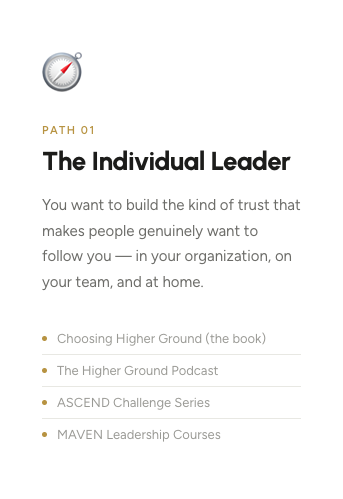
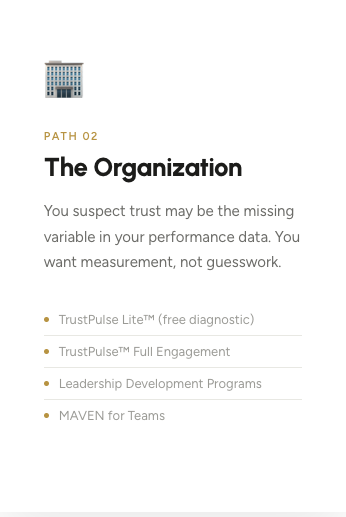
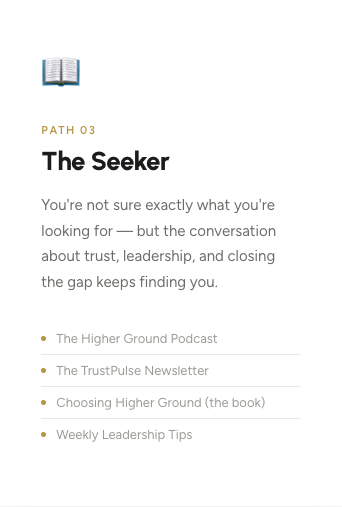
Which one are you?
THE STORY BEHIND THE FRAMEWORK
40 years.
One hard lesson.
For four decades I sat in the corporate leadership chair and watched good companies struggle because trust was broken and no one knew how to measure it.
I've lived the regret of decisions that looked smart on a spreadsheet but cost us talent, customers, and years of momentum. I've watched brilliant teams fracture because leaders stayed silent. I've felt the sting of realizing too late that mistrust was the real reason growth stalled.
That's when I made the decision to spend the next 15 years building a framework that turns the most human thing in business into something you can actually measure.
"I help people and organizations close the gap between who they say they are and how they actually live — because I believe we were made for trust, and trust is the measure of the distance between those two things."
THE ECOSYSTEM. WAYS TO ENGAGE
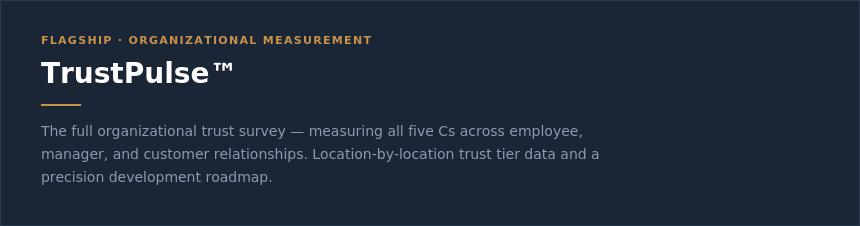
Every way to go higher.
COMING SOON
COMING SOON
START HERE
Measure what
actually matters.
10 minutes. No obligation. A clear picture of where trust stands in your organization — and what to do about it.